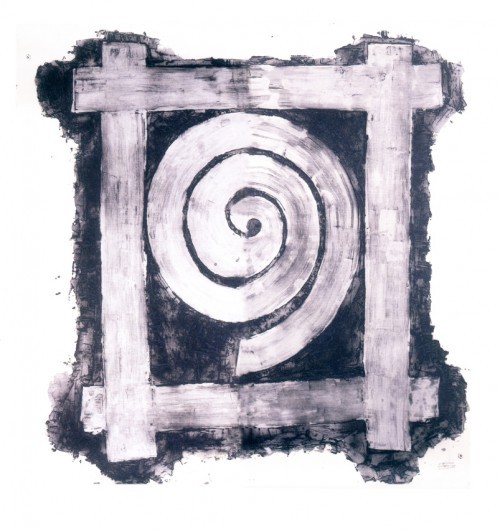
SPIRAL OF THE WIND
1991
200 x 200 cm
Etching

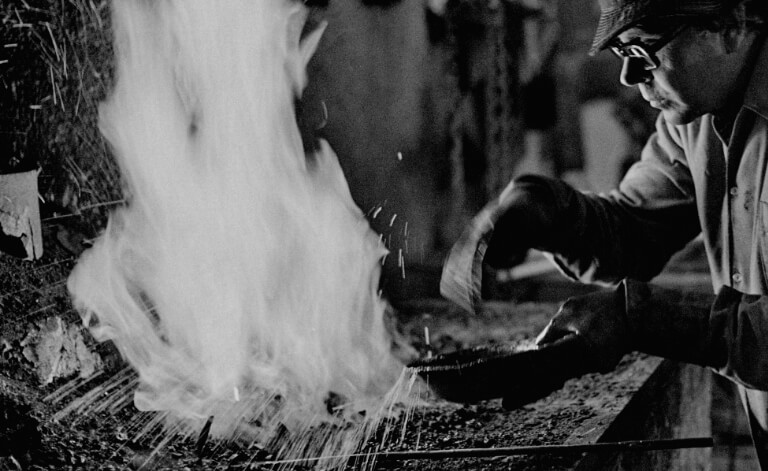
ENGRAVINGS
Although the origins of the art of engraving date back to the Renaissance, many of the most important sculptors of the twentieth century
were also engravers, and some of them were quite prolific and strongly committed to this discipline, as was the case with Martín Chirino,
who produced some 100 published engravings. Whilst the relatively flat surfaces of engravings did not appear to offer much incentive to
an artist whose vision was naturally expressed in three-dimensional form, the fact is that his engravings betray a certain tendency towards
the third dimension. Unlike his drawings or the notebooks the artist kept in order to create sculptures, the engravings were produced as
something that was genuinely and entirely new.
Martín Chirino entered the world of engraving for the sheer pleasure or challenge of being able to adapt his creative ability to new
materials and techniques, whilst also being able to reach new sections of the public. For a sculptor, who must take into account the
abstract relationships between mass, weight and the formal and psychological effects of positive and negative forms, engraving offers
the stimulating possibility of working out ideas prior to the creation of a sculpture or at the same time as the sculpture is created.