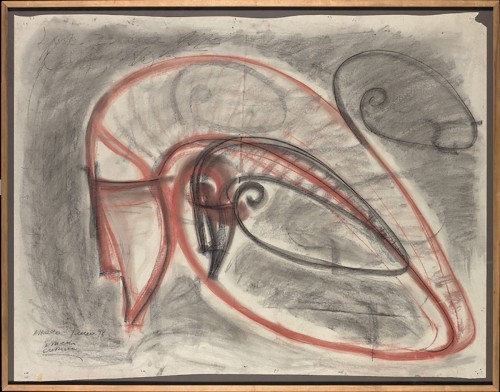
QUEEN OF THE WIND I
1998
127 x 151,5 cm
Mixed media on paper

SKETCHBOOK
As the artist himself pointed out, the sketchbooks illustrate the preparatory sketches he made for his work in iron, presenting the unfolding
tension of the creative process.
“... creating a sculpture is extremely complex. Material has its ways of behaving. Sometimes I have profound doubts that I must
resolve, and I turn to paper ... or to the earth. You have to be a real craftsman of iron...”
For the sculptor, drawing may not be his main form of expression, but it is often his most common form. This is a way of working and
experimenting that is quite inseparable from sculpting, helping to resolve all of the spatial problems that the sculpture poses. It is natural,
therefore, that Chirino’s sketches as a whole should reflect the different stages in his artistic development. His early sketches reflect an
academic style that already revealed a special approach, works that would later take on the more schematic form of his sculptural
creations, going on to complete the circle by ending up at the point of departure: another separate drawing, be it one based on a
reinterpretation of an already-created sculptural figure. Nevertheless, his drawings and sculptures would progress in a parallel manner
throughout almost his entire artistic career. These sketches were generally created using traditional media (India ink, wax, pencil, etc.)
and it is through these creations that we can best glimpse the artist’s sense of humility, a kind of shyness that prevented him from
exhibiting in a medium that presupposes by its very nature an intimate insight into the sculpture’s world, the inner mechanisms of his
creative process. With his hands, the artist expresses himself on paper through coal soot, the very same carbon used to fire the forge, as
a kind of sublimation, turning his drawings into an exercise in modernity through the use of new materials. And all this is based on an
imaginative and restless spirit that serves to relieve his inner vertigo, giving rise to a strange subconscious world, one that enriches his
entire work with an evident dose of vitality.
Naturally, Chirino’s sketches are those of a sculptor. What guides the artist’s hand is not so much the visual appearance but the
three-dimensional knowledge of the object; the line is not so much descriptive as prescriptive, illustrating what can be achieved with
sculpted material. In these two sketchbooks we can enjoy both the visual pleasure and enlightening possibility of following these
procedures, whilst appreciating what remains, what changes, what is transformed, what emerges and what disappears from a figure that
passes through the stages of sketching the natural item, creating the sketch of the sculpture and proceeding to the theme of another
original sketch through the use of these new techniques. These drawings, as a complementary part of the sculptural project, provide a
medicinal remedy to the master-creator, representing a form of rest for the warrior by helping to alleviate the mighty endeavour entailed
by the forging process.