POETIC AND USELESS TOOL
1956/1957
302,5 x 73 x 22,5 cm
Forged iron
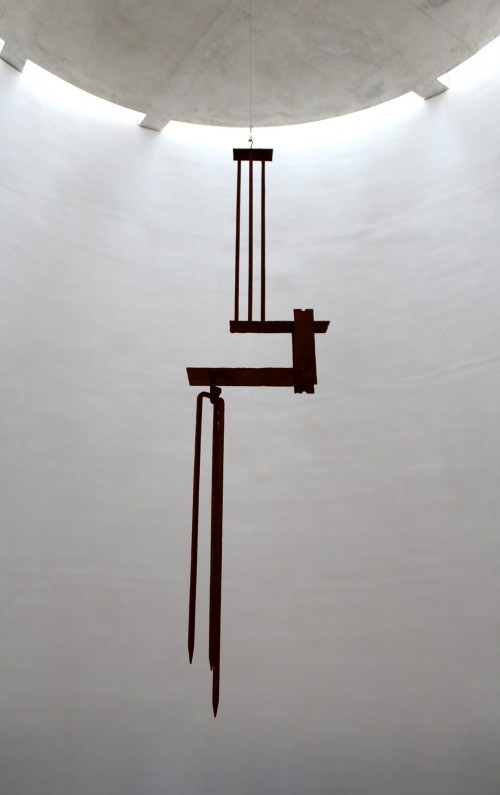

POETIC AND USELESS TOOL
“My Herramientas poéticas e inútiles (Poetic and Useless Tools) revolve around the idea of the futility of expressing oneself in a world dominated by fear, in which everything new is dangerous”
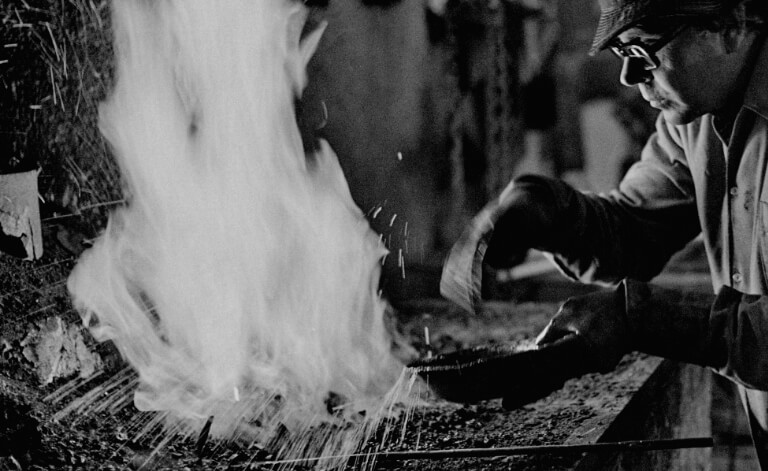
In 1952, as was virtually mandatory at that time, Martín Chirino embarked on a journey of “discovery” to Paris, where he had a chance to see Julio González’s exhibition organised by Jean Cassou at Musée Nationale d´Art Moderne de la Ville de Paris. He perfectly understood the proclamation of an “Iron Age” in which that hard material would be placed in the “pacific” hands of artists, and thus became “an insolent disciple in the school of space”. Chirino noted that his trip to Paris had afforded him his first up-close and personal encounter with Spanish avant-garde art, acquainting him with the sculptures by González, whose influence on his work would be crucial, leading him to pay close attention to tools: “Standing before Julio González’s work—the delicacy and violence of its powerful silence— my first thought […] led me to understand the use of tools, an indispensable condition for becoming a member, proficient in the craft, of the brotherhood of the forge, of the smith who reads iron, of the guild of ironsmiths”.
His works from 1955 to 1957 and 1958 move in the orbit of what he understood as the poetry of Informalism. Forging is an original procedure in young Spanish sculpture, and the expressive effects on the material, as well as the evocation of farm tools like ploughs, ploughshares, scythes and sickles, draw one's attention. But what stands out above all is the linear and, at the same time, spatial construction of these sculptures. Their sobriety and their transience, the familiarity of a material that is authentic and that must be worked in an authentic manner, in the hammering of the smith, in the direct expression of force, of precision, of movement. There is something paradoxical about that proximity between the tool, the instrument that makes it possible to rule the world, and poetry, that word that knows that the earth is a bottomless source of meaning.
Chirino’s “tools” float or rest lightly on the ground, they are not there to be touched or to be used for some specific task, but rather, to the contrary, they show us that poetry is for naught. Chirino, master of the curve, follows to the letter his aesthetic creed of “less is more”, using a minimal amount of matter to achieve more expressiveness, but seeking, above all, poetry and suggestion by means of physical effort, hammering in the forge, controlling the strength of the fire, making the blacksmith’s tools “work” to meet the most intense artistic purposes, establishing an artistic meditation about how we relate to the world and how to achieve fertility of imagery.