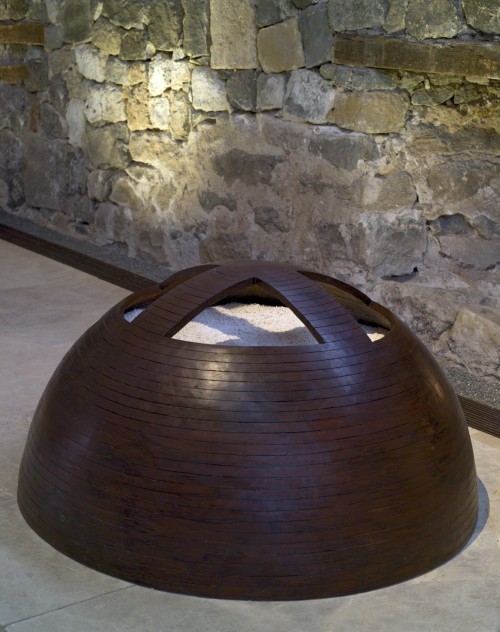
MY HOMELAND IS A ROCK IV
2006
65 x 130 x 130 cm
Forged iron

MY HOMELAND IS A ROCK
«This is the starting point for my work. On the unstable land on which I stand, it is my solid reference».
At the beginning of the 80s, Martín Chirino also produced some other unique pieces on a large scale, which did not correspond to any of his previous typologies; the spiral now grows above itself, from the ground, forming near perfect circles that close slightly at each turn. In this way he creates a structure whose top closes in on itself, rather like a dome. Or quite the opposite, the spiral starts to open up and to turn nearly perfectly, as if for a moment attempting to evoke concentric circles, and advances slowly down barely moving away from its previous course, and it constitutes a little hermetic dwelling, asphyxiating even, affixed to ground. When looking for a title, Chirino remembers a well-known poem by Nicolás Estévanez, the 19th century Canarian writer, and chooses one of his final verses for this series of winds which have unfolded since 1987. This poem evoked the mansion, the house, the island, and therefore, his childhood home where he saw the dawn for the first time; it was also an edge to a territory that could break away unashamedly from any other political and cultural centre. My homeland is a rock, by Chirino, is, above all, an image of the world, even though it might evoke a space for national identity, as it does in Estévanez. “The rock- Chirino points out- is a symbol I also cling on to, the feeling of all that keeps me going; for me the rock is my longing for the islands from my remote position”
Chirino would transform the wind into rock and homeland, thus generating that categorical semi-sphere, a hermetic dome that imposes its highly intense presence. A space is created there for a nearly spherical dream, a world that harks back to the prophetic knot.
These memorable pieces, folded in a Baroque manner, entice the viewer to delve into the poetry of intensity, where the lines and rigidity of the metal give way to an incredibly beautiful modulation of space. In the spiral, Chirino finds traces of the origin, in tune with Bachelard’s observation in The Poetics of Space, that when man looks inside himself moving toward the centre of the spiral, he often ends up errant, seeming to enter an abnormal sort of “prison on the outside”.