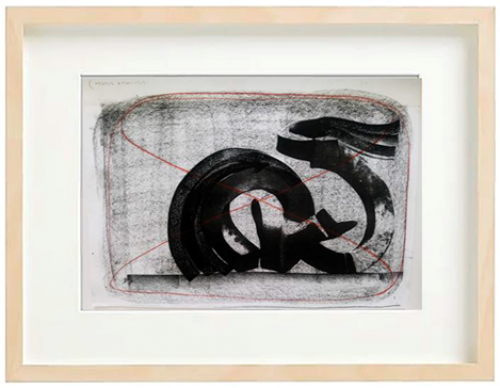
Lady Harimaguada IV
2010
29 x 41.5 cm
Mixed media on paper

LADY HARIMAGUADA
As is only to be expected, the master’s character was forged by his life experiences. In fact, he referred to himself as the “forger of dreams and symbols” and the sculpture by this “fable-forging ironsmith” is a spiral. Whether more concentric or eccentric, the wind is at the core of his artmaking … and would remain central to all his work in one way or another.
The artist once said: “The Wind, the wind comes from the darkness of remote times and is present not only in the aboriginal culture of my homeland but in many other cultures. Perhaps for that very reason, in my hands the spiral became a key element in modernism. As a young man, I was amazed to discover it in different aboriginal archaeological sites in the Canary Islands, like those in Julan, Teneguía or La Zarcita.” As he explains, the spiral is an unsettling gesture with dark origins, a mythical reference that emerged from the memory of now forgotten civilizations to become the emblem of the ancient fatherland of peoples and races, enduring as a mysterious legacy for the difficult interpretation and knowledge of its history. An emblem that embraces the whole of his work.
In 1968 he created Lady Lazarus, the first of the sculptures in his “Ladies” series, as a tribute to the irresistible beauty of a poem by Silvia Plath. This iconography, inspired by aboriginal Canarian femininity, came about as the result of Chirino’s countless visits to the British Museum in London. There he contemplated with fascination the set of sculptures of women, particularly the seated female figures from the pediment of the Parthenon in Athens. Lady Harimaguada, which takes its name from a Canarian goddess, is also from this series, and the sculptor decided to cover it in white to echo the colour of the sea foam, therein the proximity to the sea for the chosen emplacement.