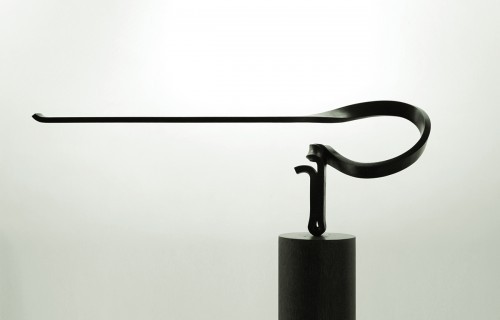
TRIBUTE TO MARINETTI XVII
2014
67 x 200 x 37 cm
Forged iron

TRIBUTE TO MARINETTI
Chirino never ceased to bear in mind the historical avant-garde, and it was foreseeable that he should turn to Futurism, thus paying tribute to Marinetti, interested as he was in the spiral, the wind, the flight of birds, swirls of water and the twisting of the Sabines, in a beautiful series, revisiting the defence of speed by means of a spiral that opens up in a delicate line, accepting the openness of the sculptural figure to its surroundings proposed by Boccioni.
¨…I was inspired by the Futurism of Filippo Tommaso Marinetti to favour that idea that speed only exists when it is executed. If one runs a lot, one is swift. And this is the most appropriate and analogous depiction of a changing world: a feeling of perpetual movement…”
El Homenaje a Marinetti (The Tribute to Marinetti), the founder of Futurism, also emerges from a subject that the master was passionate about and that he never ceased to perfect, expanding the challenge that aspires to transform space, giving the forging of iron the speed and the rampancy of an immense flourish. A spiral opens up with a fascinating elegance, a delicate stroke, almost like a hand-drawn flourish. However, it is not merely the thrill of the gesture of hammering that is rendered visible, but the “tactile” pleasure of the folds, the intensity of a material exposed to a search for harmony.
Indeed, the boldness of taking to the extreme the contrasts between such a resistant material and the fold that imposes its will is what actually incites in us, when viewing Chirino’s work, that unique emotion of participating in the creative power of his work.
“The general aim of the Futurists was to achieve an interpretation of the work of art with the formal, atmospheric surroundings. WE OPEN THE FIGURE BY BREAKING IT AND ENCLOSE IT IN AN ENVIRONMENT, declared Boccioni, placing the utmost emphasis on this. The pavement can jump up and stand on the table; the head can be moved to the other side of the street, while the lamp weaves a cloth of plaster lightning bolts between one house and the next”