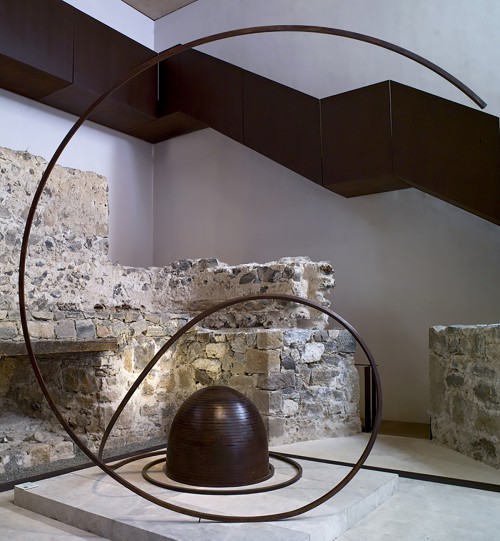
GIGANTES QUE NO MOLINOS... TRIBUTE TO EL QUIJOTE
2005
326 x 310 x 260 cm
Forged iron

Very few literary works have inspired such a wealth of artist expression as Don Quixote. Since it was first published, there have been countless illustrated editions of the novel and a host of sculptures, drawings and paintings that have brought to life in our collective imagination the character and adventures of Don Quixote and Sancho. Over the years, awareness grew of the timeless modernity of this "novel of novels" and more and more artists looked to it for inspiration. In the end, it came to penetrate the, theoretically impenetrable, borders of 20th-century avant-garde art, one of the founding premises of which was to abandon all trace of the narrative figure.
Martín Chirino took the opportunity to create a modern reproduction of the iconography that has accompanied Don Quixote throughout his journey, one of the most powerful cultural legends of Spanish culture. Chirino drew inspiration from one of the interpretations of the Wind (los Solanos) combined with the teachings of Julio González ("drawing in the space") to create a piece with a heavy centre but which becomes so light that it appears to levitate in the air.
"The spiral of iron, a material that had become very heavy in my practice, opens up to float in space, like the distorted horizon of the dream that has always pursued the art of Sculpture, demanding the freedom to be itself. Alisios, Alfaguaras and Solanos, ultimately all of my work is indebted to this iron spiral which, beginning at a closed central point, unfurls and hovers in space to instil in the material of these sculptures a sense of levity, lightness and freedom to which all of my work aspires."