THE WIND
1968
49,5 x 47,5 x 12 cm
Forged iron
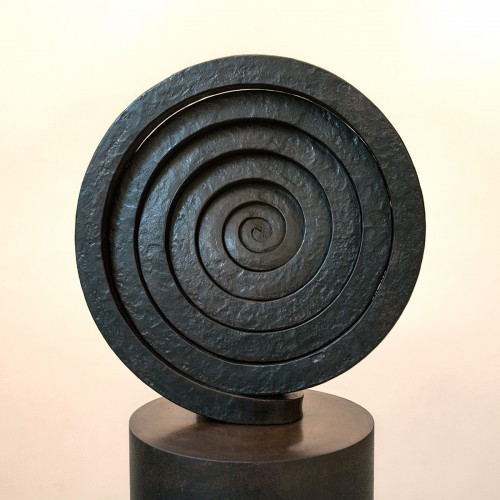

EL VIENTO (THE WIND)
Martín Chirino acknowledged that in his imagery the spiral and the wind were inseparable, and he sometimes emphasised this by naming some of his pieces wind spirals. “The spiral is, without a doubt, the protagonist of my work, the subject I have remained faithful to, which is still a constant in my creative work. But what comes first: the wind or the spiral? My primeval image is that of a spiralling wind: when, as a child, I watched how the wind caused the sands of the beach to swirl. I realised that this was not something I could touch, that the swirling came and went and that the sand flew, like Icarus. At the same time, I saw the hulls of the ships beached in the harbour, and that was my first contact with iron. I immediately perceived this contrast between the volatile wind contents and the iron container, and the outline of that clash is, itself, a spiral. Paul Klee shows us that his brushstroke is a source of accumulated energy reaching toward the centre and to infinity; a crossroads at which birth and death meet. Throughout history, particularly in prehistory, the spiral has been a symbol that is as commonly used as it is unknown. I know it is there with my Canary ancestors, although we do not know what it means; it was a symbol linked to the summer solstice, to the way the aboriginal Canary people worshiped the sun.”
El Viento (The Wind) is key to understanding Martín Chirino’s mature production. It is related to the spiral, which the artist saw as a symbol of the Atlantic, but also the Mediterranean, emulating the nature of his native islands. El Viento begins to materialize, capturing the intangible in the most condensed material, in iron or steel. Its entire vertiginous power is anchored in convulsive spirals, some more tightly wrapped than others, that are about to come loose.
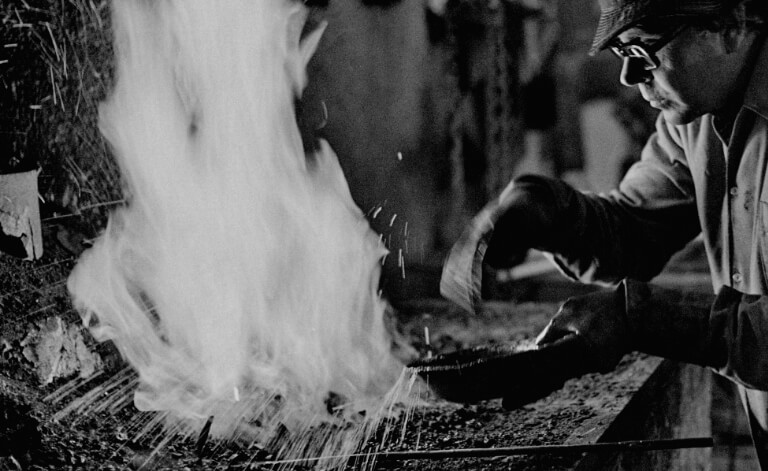
In the spiral, Chirino finds traces of the origin, in tune with Bachelard’s observation in The Poetics of Space; when man looks inside himself moving toward the centre of the spiral, he often ends up errant, seeming to enter an abnormal sort prison on the outside. “Before Chirino came along”, Serge Fauchereau points out, “nobody had ever thought of sculpting the wind”. Martín Chirino noted that hot iron vibrates, flows, sprouts and lives in his hands, causing a sensation that is hard to explain. It has marked out a path which takes him spiralling back to his origins, with an essential formalization, allegorizing hope, and recovering beauty as a promise of happiness. “The iron spiral is closed at its starting point, and is stretched and flattened so that the material suggests a simulation of lightness and levity, that some of my works aspire to achieve.”