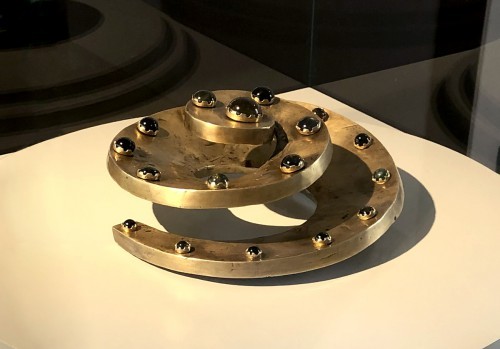
THE MYTH OF SISYPHUS II
2007
10,5 x 23,5 cm
Silver with gold plating and 19 round turmalines

THE MYTH OF SISYPHUS II
Since the early twentieth century, painters, sculptors and architects have taken an interest in the decorative arts and, more
specifically in the arts of adornment, renewing a tradition that began during the Renaissance with Cellini, who would involve
creators in all forms of artistic expression. This movement grew under Catalan Modernism and continued to gain
momentum after the Second World War. In the 1920’s, Alexander Calder was the first artist to achieve success by making
jewellery items based on modern sculpture. He even designed mobile pieces that came to life due to the movements of the
wearer’s body. In Germany, the Bauhaus movement extended the range of materials employed by artists in order to create
jewellery pieces. For the first time, this School considered handicrafts to be almost on a par with the fine arts. Alberto
Giacometti created his first jewellery pieces in 1935, as the result of a failed attempt to design buttons for the Italian
designer, Elsa Schiaparelli. Being made of bronze, the buttons were turned down for being too heavy, so the artist made
them into pendants and brooches for his friends. Closer to home, Spain also witnessed the creation of jewellery items by
artists such as Picasso, Julio González and Dalí, amongst others. They all made sporadic incursions into the world of
jewellery based on their corresponding historical avant-garde perspectives.
Inspired by the myth of Sisyphus (symbol of the philosophy of the absurd, as a metaphor of the useless and incessant
endeavours of Man), Martín Chirino entered the world of precious metalwork in order to create a spiral made out of
gold-plated silver, replete with 19 embedded tourmalines and featuring a deliberate handcrafted appeal ... "I worked the
piece in a Visigothic manner, without resorting to molten gold and featuring a natural appearance."
In the image and likeness of the aboriginal seals of the Canary Islands, the pintaderas canarias, the sculptor remained
faithful to an ongoing motif in his work, a tendency towards helicoidal forms. The spiral is a common denominator
throughout practically all of Chirino’s work, the result of the research he carried out into his ancestral culture.
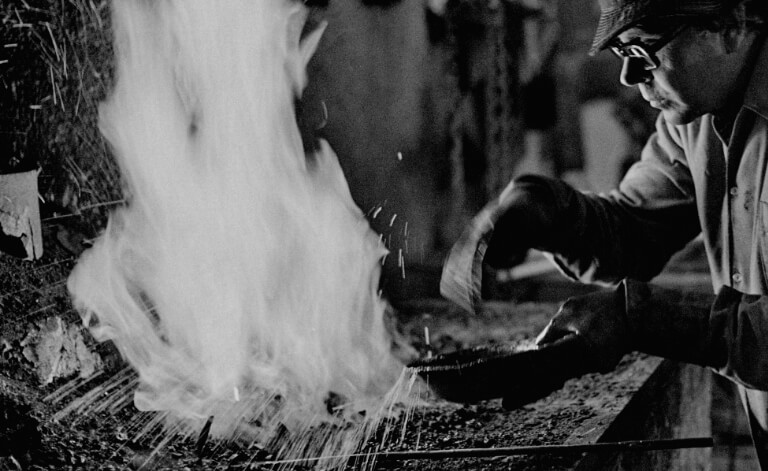
Another important aspect is our ability to appreciate the hammering work on the surface of the gold, a technique with which
he moulded the material, leaving behind the scars and indentations of the battle. This was a key question for Chirino, an
artist who made substance out of gesture and struggle in order to express his artistic personality.
This sculpture/jewellery item sets up a clear interdisciplinary dialogue with the rest of Chirino’s work, since, as Otto Wagner
once said, “creating a work of art means expressing beauty, without making any distinction between large or
small.”