- ESPAÑOL
- ENGLISH
- Foundation
- Collection
- Visits
- News
- Education
- Foundation's Friends
- ESPAÑOL
- ENGLISH
- Foundation
- Collection
- Visits
- News
- Education
- Foundation's Friends
26/09/2023
ARCHITECTURE WEEK
ARCHITECTURE WEEK 2023 THE FOOTPRINT OF ARCHITECTURE: CITY AND SOCIETY MIGUEL MARTIN-FERNÁNDEZ DE LA TORRE SEPTEMBER 29 – OCTOBER 6 The Official College of Architects of Gran Canaria and the Martín Chirino Foundation, in collaboration with the Cabildo of Gran Canaria, will celebrate its IX Architecture Week 2023 from September 29 to October 6, being the annual event of greatest social relevance for this institution.
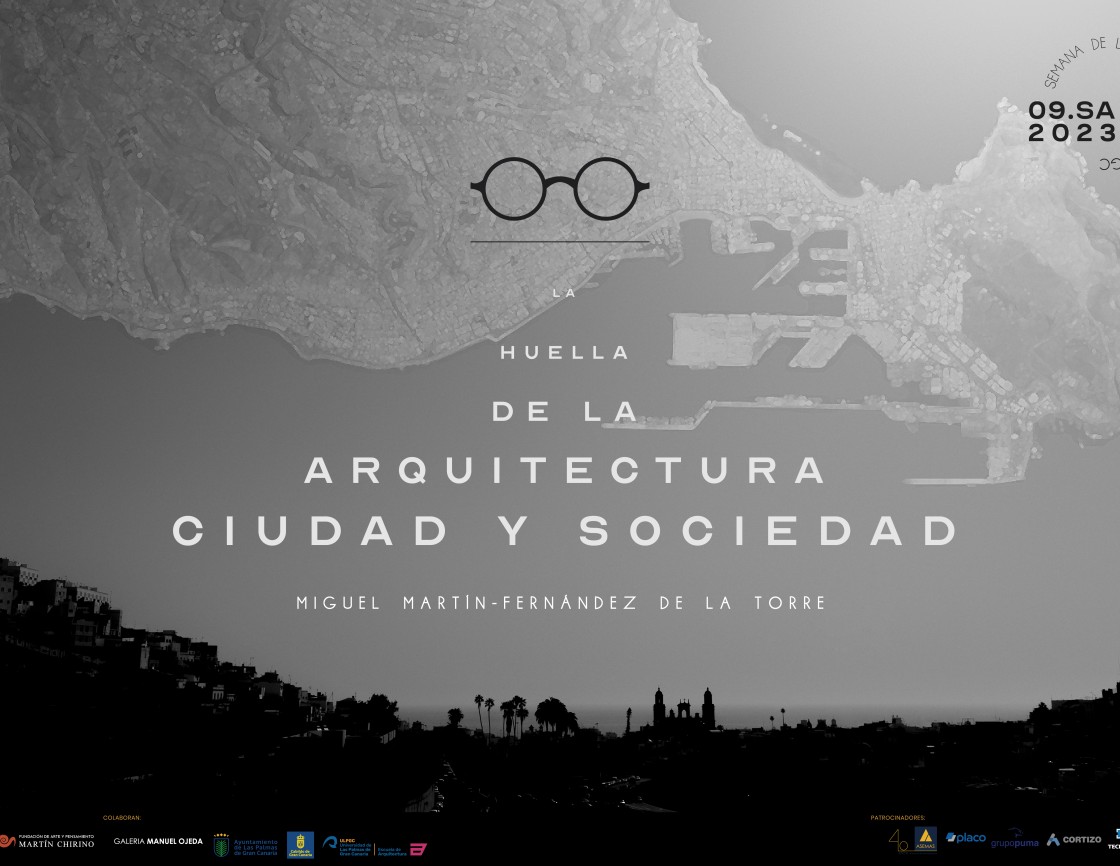
In this edition, with the motto “The footprint of Architecture: City and Society – Miguel Martín-Fernández de la Torre”, it is proposed to initiate a joint, continuous and critical reflection, beyond disciplinary and temporal boundaries, about the configurative processes in the definition of the most appropriate architectural footprint with which a society marks its mark on the physical environment in which it lives: both in its built space and in its natural space. Configurative processes that, originating in and from diverse areas of our society, through the constructive confrontation of ideas and the debate of the objectives to be achieved serve to reinforce the indispensable link that must always exist between architecture and citizenship. In the 1920s, our island society was also a post-pandemic society that, even though it was affected by the consequences of the “Spanish flu,” wanted to take on the challenge of its modernization motivated by the imminent achievement of its long-awaited goal. consideration (along with Fuerteventura and Lanzarote) as a new province of the Canary Islands, prelude to the subsequent shared regional capital of the city Las Palmas de Gran Canaria.
In 1922 Miguel Martín-Fernández de la Torre returned to Las Palmas de Gran Canaria, at the request of Mayor José Mesa y López, with the aim of undertaking the expansion and modernization of our city; thereby initiating a process of configuration and planning of its future urban developments and architectural milestones whose footprint our society continues to consider as an essential reference. Throughout his extensive professional career he was an enormously prolific architect, covering a wide range of programs, scales and even different visual arts; localist at times and avant-garde at specific moments, a story of the urban condition of our city is not possible without alluding to its figure and its special fit with its society. That society full of desires for a better future found in the figure of this architect, among others, the operator capable of building the desired image of itself, and this constituted a special scenario where the particular interaction between architecture and citizenship made it possible to configure spatial and culturally a valuable series of happy episodes in a natural relationship. The current scenario is no longer that, various interferences have altered that relational bond in our contemporary society, in which it seems that how to intervene, in the most appropriate way, in our physical environment in accordance with the general interests of our society has ceased to have its due importance for the decision-making agents concerned.
The general interests of our society, as a whole, regarding the qualitative aspects of the environment in which it lives are timeless and transcend beyond short-term visions based on particular criteria and interests. Our cities are located in an island territory that, because it is fragile and limited, requires greater care with the traces that we find and leave there. Opening reflective debates, starting from here and now, to choose to improve our perception and ways of acting, that of all of us, is our option that we pose here as a challenge for the present and with the future.
You may be interested in: