- ESPAÑOL
- ENGLISH
- Foundation
- Collection
- Visits
- News
- Education
- Foundation's Friends
- ESPAÑOL
- ENGLISH
- Foundation
- Collection
- Visits
- News
- Education
- Foundation's Friends
30/06/2025
"Chirino is an unclassifiable artist and his work overflows the genres of all schools due to its uniqueness"
The director of the Martín Chirino Foundation of Art and Thought, Jesús M. Castaño, takes stock in this interview of the different actions, including exhibitions, publications and other events undertaken this year on the occasion of the centenary of the birth of the sculptor Martín Chirino. An event that coincides with the tenth anniversary of the artist's Foundation, which is based in the Castillo la Luz.
The centenary of Martín Chirino's birth has positioned the sculptor's work and figure nationally and internationally with various exhibition projects, in addition to the impact that his legacy has on his native island with productions such as Crónica del siglo, exhibited by the Atlantic Center of Modern Art or El Paso. Avant-garde and Commitment, which can be visited at the Castillo de La Luz, headquarters of the Martín Chirino Foundation of Art and Thought. What balance can you make of what has happened to date around the commemoration of the centenary?
The centenary year is, of course, an intense period of work and a lot of effort on the part of Martín Chirino's family, as well as the work team that is part of the Foundation. A year to celebrate the birth of our sculptor exactly 100 years ago, everything that his life and work meant and the repercussions he had on the national and international artistic scene. A year to thank all the public and private institutions that have helped us to carry out the intense and ambitious programme. A tribute, a recognition, for which Martín Chirino gathered throughout his life the merit he receives today, and which is being fulfilled as we project. I would like to highlight that all this development of activities has been planned for three years now with the various institutions and spaces, which has allowed us to deploy so many events with the small team we have at the Foundation. It is gratifying to see the historical debt that this city had with the artist to exhibit in what was a historical milestone for this city and its repercussion outside it, such as the creation of the CAAM by Chirino. This centre has become the best sanctuary to host the retrospective that houses his legacy, which ranges from his first sculptures to his latest. An art center dedicated entirely to the work and thought of our founder. At the same time, at the headquarters of its Foundation, in the Castillo de La Luz, we host an exhibition El PASO. Vanguardia y Compromiso, which is an exceptional opportunity to bring the public closer to this essential chapter in the history of Spanish art, which represented an international projection such as has rarely been seen among our Spanish artists. In addition, events linked to Martín Chirino have been held at the Foundation's headquarters, such as the choreographic piece Forjando Vientos, by Anatol Yanowsky, or the PSJM mural, a plastic tribute to Chirino's professional life.
Martín Chirino's legacy has also had a national and international projection in the centenary year.
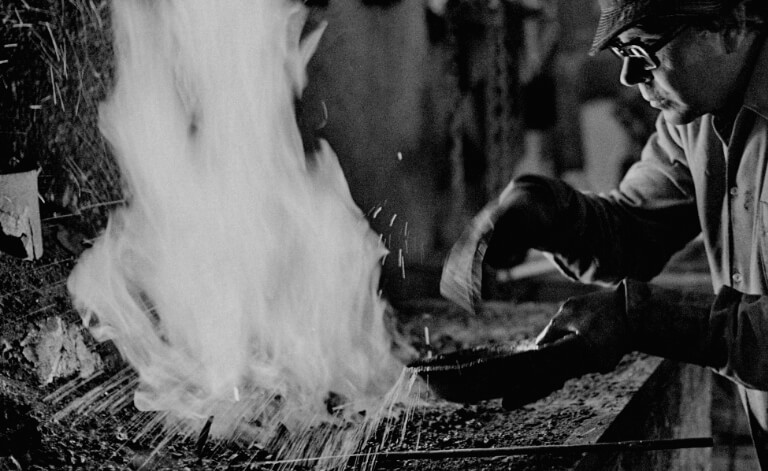
Now at the Niemeyer centre, in Asturias, we have an exhibition that covers the American period, perhaps the least known of the sculptor by the public, and which was so fruitful. In addition, we have just closed two exhibitions on Chirino in Rome, at the Cervantes Institute, and at the rectorate of the University of Las Palmas. At the end of the summer We opened two more exhibitions in Madrid, one at the Círculo de Bellas Artes and the other at the Guillermo de Osma Gallery. All these exhibitions work on different aspects within the sculptor's creation, and their theses are written by eminent experts in the field. It is an analysis that reviews his figure from different angles, to build a global vision of a lifetime dedicated to sculpture and cultural management. A merit that as an intellectual and artist accompanied with his lucidity the development of the plastic arts of this country. Chirino's contribution to culture is unquestionable, thanks in part to his multifaceted and visionary character. He is an unclassifiable artist and his work overflows the genres of all schools due to its uniqueness. Those of us who were lucky enough to share small and big moments with him know of his quality as a person and his good work. A blacksmith who always forged the content that came and went to his mind, respecting the language and his commitment to contemporaneity. A work behind which he hid a serious and profound reflection. It has been a year of good reception by the public and by the specialized press of all the actions we have carried out. A year to celebrate.
The exhibition on El Paso, of which he is the curator, offers a selection of significant work by this group of artists who were avant-garde in their time. What does this project promoted by the Martín Chirino Foundation mean in the context of the sculptor's centenary?
This year we stopped the programming of the exhibitions that I have been designing during these years. In them we have been showing Chirino's work by series, accompanied by their corresponding monographs, in which different experts in different disciplines intervene, aligned with each series, and in which the work is contextualized. We are publishing them to complete what we have been calling the Chirino Encyclopedia. I stopped that project to present Martín Chirino's participation in El Paso, in line with what I said before analyzing different facets of the artist and his projection in the year of the centenary of his birth. I am proud of the work and study done. We have managed to get leading institutions and prominent collectors to lend us significant works from this period. It is a very good opportunity to approach this essential chapter in our history, something that had not been seen in the Canary Islands before. The rooms of the Castle reproduce the spirit of the time with great beauty, always thanks to the quality of the works on display. We have also managed to bring together almost all the original publications of the brief period that marked El Paso's incursion into the history of Spanish art.
A lecture of his on El Paso scheduled for July 2 is also an opportunity to elaborate on the role that this movement had in Spain at the time and in the history of art.
Yes, in it I intend to bring the audience closer to the repercussion and importance that this group had in the History of Spanish Art and of which Martín Chirino was a member since 1958. An artistic group whose mission was, according to its founding manifesto, "to invigorate Spanish contemporary art" to which it was attributed "to be lacking constructive criticism, dealerships, exhibition halls that guide the public and fans who support all innovative activity". To do this, I will rely on a series of works by all the participants in the group, both those present in the exhibition and others that the artists produced on the dates on which the group was in force. El Paso, in Saura's words, meant "a common acceptance of informalism". In this movement, the predominance of the somber range, of black and white, the absence of color, in which the forms, the expressive gesture, and where the "Hispanic" tone was emphasized: tragic and profound. A true "action group", with a very well thought out strategy of attack and self-defense, supported by a group of art critics, as well as a large group of intellectuals interested in the proposal. The presence and performance of EL PASO was decisive in renewing the artistic environment in the country, stirring up waters and provoking the spread of the debate around the controversial insertion of informalism within the Spanish dictatorship.
The Martín Chirino Foundation celebrates its tenth anniversary this year. How has the work been in these years until you arrived at the Foundation that we know today?
An intense and fruitful work. In these years we have established ourselves as a benchmark institution, both in the Canary Islands and outside the archipelago. We follow the path that Chirino himself marked out in his work and thought, which is none other than "from the Canary Islands to the world. From the particular to the universal." A work that has been recognised in 2021, when the Council of Ministers, at the proposal of the Minister of Culture and Sport, Miquel Iceta, awarded us the Gold Medal for Merit in Fine Arts, and this year, in which the City Council of Las Palmas de Gran Canaria has awarded us the gold medal of the city. From the outset, and working side by side with Martín Chirino, we proposed a roadbook that had three fronts to cover. On the one hand, the work for and for excellence, better few and good activities than many and regular ones. We are a centre that is due to a plastic artist, obviously, but in which we make concessions to other artistic disciplines, without this turning us into a theatre or auditorium. Another open front is also the immediacy of cultural consumption today, and we have proposed from the beginning a deepening of the topics we cover, avoiding superficiality in the analysis. Finally, the Foundation starts with the aim of becoming a centre for dissemination and debate around culture, in the privileged environment provided by the Castillo de la Luz. I am aware of the limitations we have, both in terms of personnel and budget and space, and I try to adapt these proposals to the reality of the headquarters, without trying to compete with other specialised spaces, but by making proposals that match our philosophy and go to meet our architectural space and its history. I have known Martín Chirino since 1996, and we have worked together since then, many years in which we have debated and reached a mutual understanding of the future of the institution and the values it needed to transmit to society.
The tenth anniversary is a celebration that allows us to rethink the role of the Foundation as a space for art and thought about the legacy of Martín Chirino. After the extensive agenda of actions for the centenary, what will be the Foundation's roadmap from next year?
The roadmap is to continue consolidating the projects we have been developing, such as completing the Chirino Library, positioning our Artistic Residency internationally, resuming our Martín Chirino International Composition Competition, continuing with the study and contextualization of Chirino's work, his perfect cataloguing and digitization of all his documentary legacy to make it visible and accessible to future generations. It is true that we have a considerable budget, whose main supporter is the City Council of Las Palmas de Gran Canaria, but a large part is allocated to the maintenance and services of the opening of the space to the public, which leaves us with a limited budget for programming. In the future, the ideal would be to have more support, both institutional and private, to be able to expand the cultural offer and open more lines of work and increase the workforce. We already have occasional support from public institutions such as the Ministry of Culture, the Government of the Canary Islands and the Cabildo de Gran Canaria, as well as from the private institutions CaixaBank, the DISA Foundation and the Acuorum Foundation, and I maintain a close relationship with all of them. It might seem enough, but the will is to grow over time, and for that it is necessary to give more support to culture from companies, not only to our Foundation, but to the cultural fabric in general. This is a necessary change, which I hope to help push through little by little.
You may be interested in: